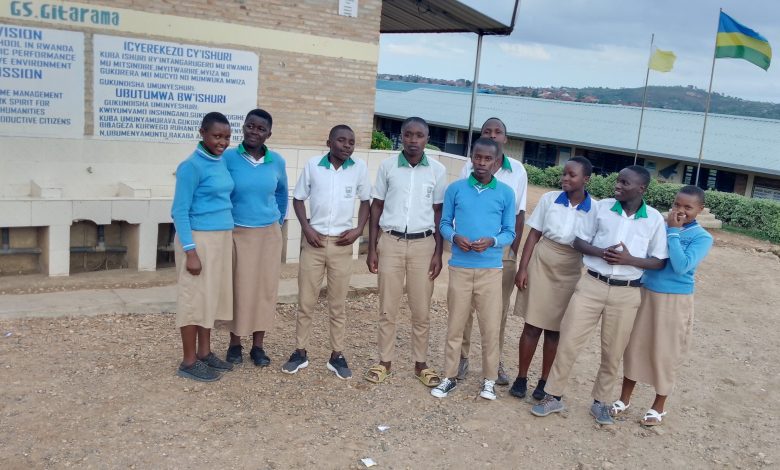
Students at GS Gitarama in Muhanga District, Rwanda, have pledged to reject behaviors that expose them to HIV, sexually transmitted diseases (STDs), and unplanned pregnancies, thanks to the guidance of their school’s Anti-AIDS Club. The club, which integrates education on reproductive health and peer mentorship, has empowered students to prioritize their well-being and academic futures.
In an interview with mamedecine.rw, students highlighted how the club’s lessons have strengthened their resolve to resist societal pressures.
Daniella Kamanzi Ineza, a club member, advises the colleagues how to behave: “There are countless temptations around us, when faced with them, saying “no” is crucial to avoiding negative consequences and staying focused on our responsibilities as students.” Says Kamanzi
Daniel Tuyizere emphasizes the club’s role in combating ignorance. “Today, no one can manipulate me into risky behavior,” he stated. “We’ve learned that promiscuity often stems from a lack of awareness. Older women sometimes try to seduce young men with gifts, but now we recognize these dangers and refuse to engage.”
Esther Niyokwizerwa adds that the club’s reproductive health education has been transformative: “We have learned how to prevent unplanned pregnancies and protect ourselves from diseases. This knowledge gives us the confidence to make informed choices.” Says Niyokwizerwa
The student Charles Iringire also highlights the importance of self-reliance. “I work hard to achieve my goals: “There’s no need to risk my future through promiscuity, it only leads to destruction.” Iringire.
Some of the Club mentors at GS Gitarama shared their perceptions with mamedecine.rw. Vestine Uwamahoro, a teacher, emphasizes compassion for those living with HIV.
“If someone is infected, it’s not the end of their life,” she said. “With medical support, they can continue their education and lead fulfilling lives.” Says Uwamahoro
Prudence Uwayezu, another mentor, explained how the club’s curriculum aligns with national health initiatives: “We collaborate with local health centers and the Rwanda Biomedical Centre (RBC) to provide students with practical tools for staying healthy. Reproductive health education is integrated into our lessons, ensuring students understand the risks and solutions.” Says Uwayezu
Géneviève Nyiransengiyumva, the Deputy Head of Discipline at GS Gitarama, praised the club’s influence: “Since its establishment, we’ve seen zero student dropouts due to early pregnancy. When a peer is at risk, club members intervene offering advice and support. This peer-led approach has fostered a culture of accountability and health consciousness.” Says Nyirnsengiyumva
According to the Rwanda’s Demographic and Health Survey conducted by the National Institute of Statistics of Rwanda (NISR) in 2019-2020 revealed that 2.7% of adults aged 15–49 are infected with HIV. Among them, 3.5% are women and 1.7% are men. Among the youth aged 15–24, those who are infected are 0.7%.
Mukamusoni Fulgencie